
Meet Henry Good Mouse
Journal Entry No. 02

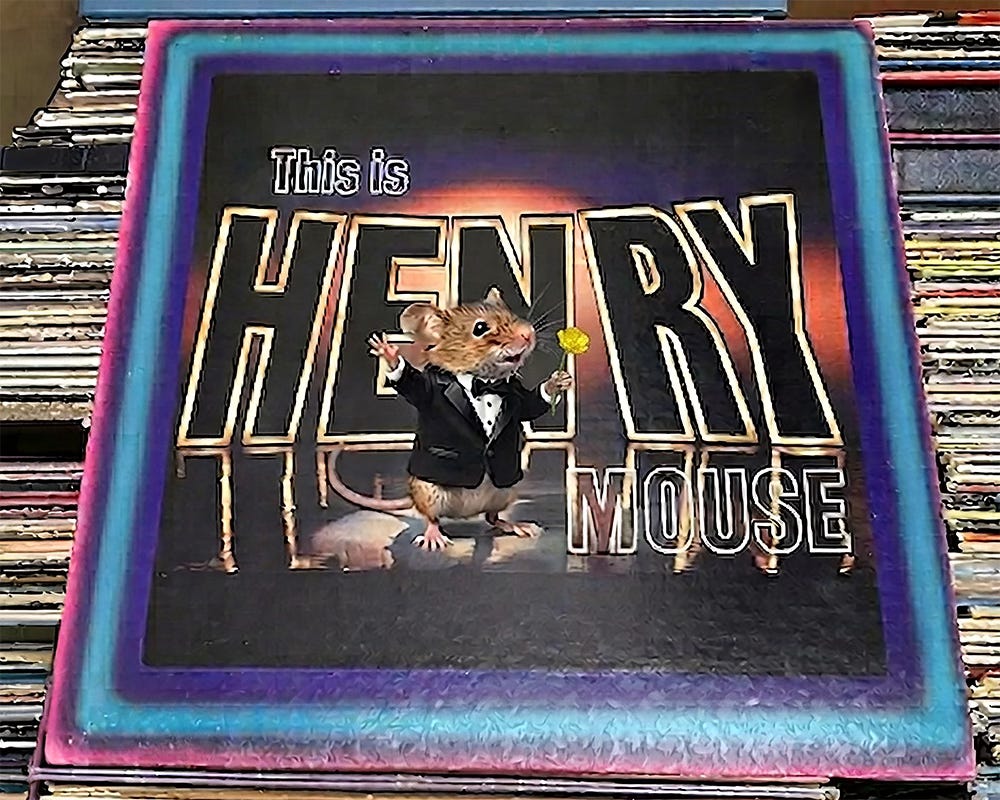
Henry was a good mouse.
Young Henry’s maternal grandfather had been a major influence in his life. His Grandpa Henry had been a mouse of letters who had walked the boards in England and enjoyed great success in his time.
From his grandfather he had acquired the love of learning.
Henry had gone to university and was well educated, but still he felt like an underachiever. Though he had undergraduate degrees, he did not have a PhD like Grandpa Henry, nor did he achieve his grandfather’s artistic or material success.
He felt behind.
Grandpa was well accomplished and enjoyed the fruits of his success, even driving a customised Mercedes sedan he had shipped from Stuttgart, from Mercedes exclusive Bedienungshilfen Manufaktur. He wore an Omega Burrowmaster on his wrist.
His Uncle Henry had the same.
Others thought that young Henry was a very intelligent mouse. Henry Good Mouse was not materialistic, nor particularly ambitious, but he felt like he had fallen short because he lacked the education and financial accomplishments of the elder members of his family.
When it came to romance, Henry was proud of the fact that he punched above his weight, so to speak. Sophisticated, handsome, and confident mice seemed to find him interesting, too. Not all of them, of course, but any more than zero seemed remarkable to him. He always felt perplexed about this. For a while he went out with a girl who seemed more beautiful and confident than him by far. It was nice being with her, but he felt that it must be due to some defect in her that she wanted to be with him.
“She’ll find me out,” he thought. He didn’t explicitly articulate these words to himself nor actually believe them, truth be told. But being with her, on the whole, at times felt to him like descending a stairwell in a strange house. A Lovecraftian feeling of being in the dark with a sensation in one’s gut that something bad might happen. Inchoate. That’s the word.
One descends the stairs and is not eaten. Like a child, one knows the fear is nonsense, but still, the feeling persists. This troubled the rational young Henry.
Beyond the thrill of being together, in quiet moments alone, “Why does she like me?” he’d ask himself.
But enough about love. Henry had gone to psychologists to try to get to the bottom of his insecurities.
He was once excited to have found a Jewish psychoanalyst in a good neighbourhood. What he considered a trifecta.
The good neighbourhood part was important to Henry. “A wealthy tax base that can afford to sue a doctor into the ground keeps a medical professional honest”, he would say if asked.
When Henry entered her office, the good doctor smiled to greet him. “Third floor window right in front of the big tree like I told you,” she said.
“Exactly,” Henry said, adding, “But I decided to use the elevator.”
“Ha ha,” she laughed. “So charming,” she replied.
“Strike one,” thought Henry. A little too flirty for a doctor, he felt.
And this psychoanalyst wore a skirt with a slip underneath that extended a few inches too far for the short skirt. She sat with her legs before her, slightly akimbo.
Strike two. Was this a doctor? Or a coquettish schoolgirl who didn’t know how to sit or wear underwear correctly?
She explained the expectations for their sessions—guidelines, disclosure, rules, cancellation requirements, and so on—and she told him about her previous work in Los Angeles. Henry imagined her ingratiating herself with entertainment industry types. Maybe trying to shop book deals. Who knows what. Ugh.
By the time she was finished, Henry had learned that she had acquired both her surname and her faith by marriage. He was not going to hold that against her because, after all, so had Ruth, great-grandmother of King David. But still… “Give me a break,” Henry thought to himself. It felt like a bait and switch.
After the session, though, he did some research and learned that her alma mater was no longer a credentialed institution. It was one of those schools championing “lay analysis,” a product of the trend toward the democratisation of degree-granting institutions, from a time when such institutions seemed to practically fall out of trees.
Henry remembered his grandpa complaining about this academic trend. “Next, there will be a University of Kung Fu offering advanced degrees in macramé. It debases the university system and renders the degree title meaningless.” Grandpa was quite passionate on this topic. Henry fully agreed.
“Tell me about your relationship with your mother,” she asked.
Strike three. Yes, he was fairly confident that his mother was part of the explanation for his current situation, although he’d bet you twenty-five cents he could tell you just as much as this so-called psychoanalyst could. His mother had once observed that his first girlfriend “was more sophisticated than he was.” He thought about this from time to time. He realised, as the analyst asked, that he did not need to spend one hundred and fifty dollars an hour (or fifty minutes) to be told this.
Henry could also have mentioned that he had some introjected ideal-self thing going on with his grandfather. “Just drop me in a Skinner box… I’d probably get more out of that”, he thought.
If he had said all of this out loud, Henry knew that he would sound like a terrible snob. And he’d agree, too: an effective ad hominem criticism. But that didn’t mean he was wrong. He would just take care not to say it out loud.
He finished the session but did not go back. He wanted more of an Adler or a Frankl. Maybe those just didn’t exist anymore. He decided to go back to the cognitive behavioural therapists he liked.
Henry took a run-and-gun approach to analysis, sometimes seeing two or three different psychologists in a month. “Play the Field and eventually you’ll find one you like”, was his strategy.
It didn’t seem to be working though, and he knew something would have to change if he was to evolve into the mouse he should be.
□