
Henry Good Mouse the Rebel
Journal Entry No. 03

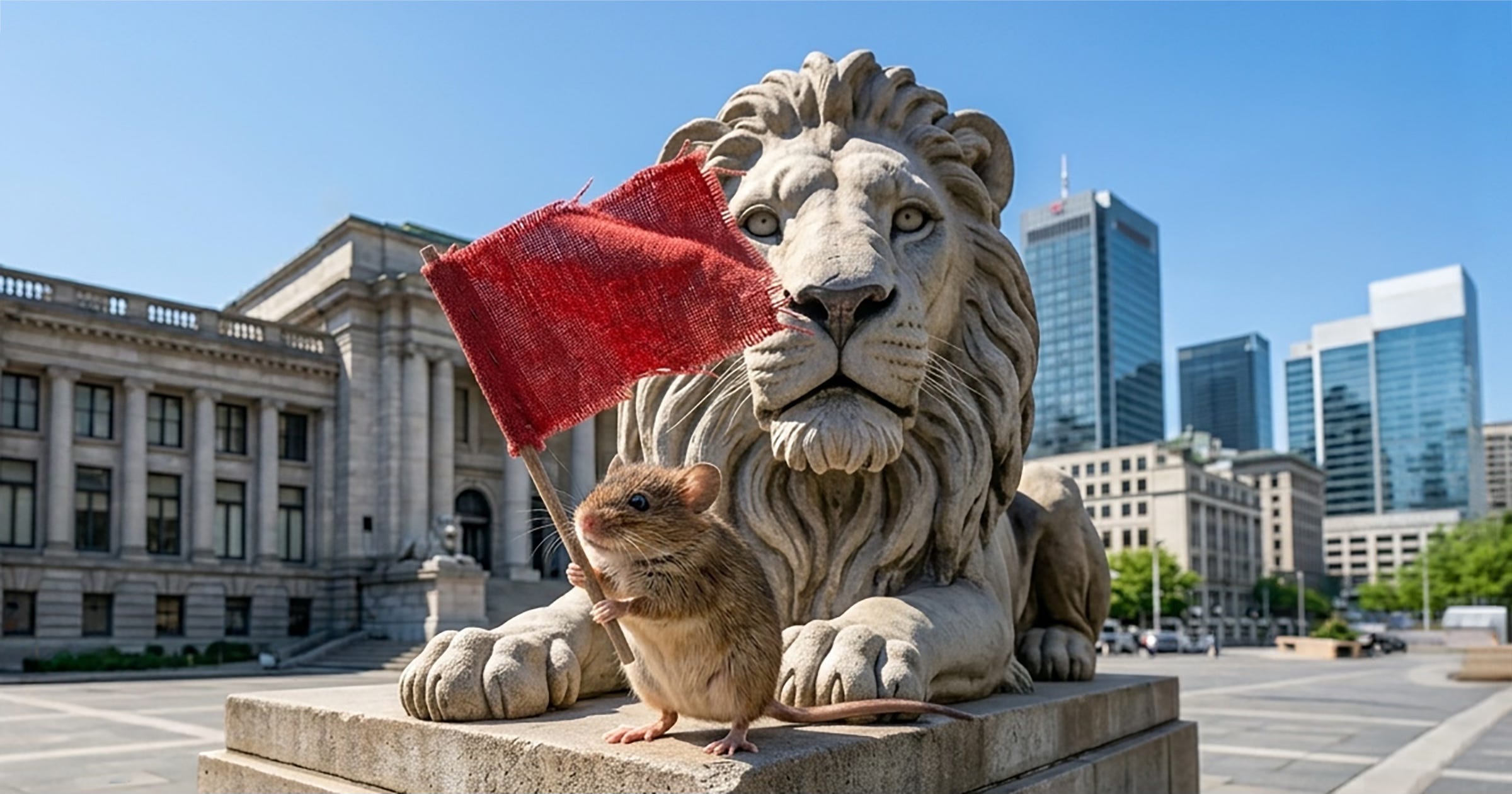
“When were you first radicalised, Goodie?” Henry Good Mouse was once asked by Maggie, back when they were young. Goodie was the nickname she had given him.
At the time, he and Maggie were sitting on the head of one of the stone lions outside the art gallery.
Henry was pleased with this nickname. “Henry the Good,” future historians might call him. That would be fine: like Richard the Lionheart.
In response to Maggie’s question, he told her the origin story of Mighty Mouse, from Semper Musculus1, Prime Minister Luchóg ‘Mighty Mouse’ Mac Eoin’s autobiography (Mac Eoin, 1996).
“Mac Eoin’s earliest memory was of being a pup of about two weeks, when his mother was pushing him through their neighbourhood in a pram. He remembered seeing a mouse stuck in a trap. The dead mouse’s family stood nearby weeping while the smallest one there tried to break away and free his father. Mac Eoin wanted to help and his own mother held him back, saying, ‘Careful, son, lest it get you too. He’s gone now.’”
“Reading that book as a child myself is when I knew I should get involved to help our brothers and sisters in the struggle”, Henry told the admiring Maggie.
Sitting on the lion’s head, he explained The Troubles to her while she watched him with a rapt expression. Henry basked in the glow of her attention.
Provo Mouse Mac Eoin’s origin story was one that young Henry would have liked to be his.
Henry’s earliest memory was actually of himself as a baby, sitting in a plastic bathtub at the top of his grandparents’ front stairs. He distinctly recalled peeing in the water while his mother bathed him, and he remembered hoping she didn’t notice.
As a child, he read all about the world’s struggles, revolutions, and their freedom fighters, identifying with the heroes who fought to lift the boots from the necks of the oppressed.
He devoured these tales the same way he did chapbooks or superhero comics, as templates for mousehood to grow into. Fantasised future selves. “What a mouse!” he hoped they might one day say about him.
As an adult, Henry was now wiser, and shuddered to think of the memory of himself posturing and pontificating to Maggie.
Henry realised much later that little Maggie probably wanted him to take her home. Henry was oblivious to this as his younger self vainly held forth. Had he been less self-involved, he might indeed have picked up on the clues and acted. Assuming he found the courage.
If asked two years later what radicalised him, he would truthfully answer, “If one has lived to adulthood and is not radicalised, then one has just not been paying attention.”
Henry still lionised past heroes who fought glorious battles. “So brave, them”. But his needs were more practical now.
A peace-loving mouse, he was occasionally overheard to say, “I don’t approve of what happened during the Great Revolution, but I do understand it”. And he meant it.
Henry remembered what his own mother told him once when they had encountered a sprung mouse trap: “He’s lost, dear. I should do something about it, but I cannot; I have a responsibility to you. But it just isn’t right.”
Now at middle-age, he would watch the food lines and the deportations on the news and say to himself: “…one day…” and continue to imagine, just like when he was young.
“The reason more mice don’t stand up to injustice is that they don’t believe in themselves”, he said over a bottle of wine at dinner with friends.
“Where are the International Brigades of volunteers? Where are the modern Freedom Riders?” he said, punctuating the air with a pinwheel crystal wine glass to make his point.
A dinner companion brought up the topic of climate change and the possible extinction of mousekind. This was a topic Henry could discuss at great length.
Someone asked about Maggie. Henry had not seen Maggie in several years. Someone else mentioned that they had heard she was recently forced to take a leave of absence from her university position after one of her students complained to her department chair.
Apparently, she had told one of her classes that she had volunteered to help with training coordination for Musculus Rebel. “…or maybe it was Mus Underground. It’s so hard to keep track of these groups”, the mouse to his left added, spearing an aged slice of mimolette with a silver cheese knife.
Henry had t-shirts and branded handbags for both groups, and their logos were pinned to the top of his social media accounts. He wanted to show that he was as concerned about inequality, climate change, and The Final Squeak as anyone.
“We must stop fetishising the bones of the saints and do something ourselves”, Henry said, taking a sip of wine. His dinner companions nodded in agreement and smiled approvingly.
A volunteer fundraiser had talked to Henry on the street the other day and told him that the two groups had merged and would appreciate any help he could offer. Unable to slip discreetly past, he made a one-time donation of ten dollars. He had taken care to ensure the recurring payment checkbox was empty.
A long-haired, pony-tailed mouse had recently come on the scene to lead the group, and was making confident steps to bring attention to resource inequality and environmental protection. He was in all the papers.
This new mouse’s followers conducted performative acts of protest intended to disrupt ordinary daily activities and to draw attention to the intolerable economic and social situation at home.
Henry disliked the antics of this new crop of protesters. They seemed foolish. Chaining themselves to structures as they chanted their rhyming slogans. So undignified.
Their leader was articulate and persuasive, and Henry admired his erudition and believed in his sincerity.
But this leader seemed too cultish to Henry’s way of thinking, as he discussed, in practical terms, the matter-of-fact logistics of training and skill development required of the mice who wished to follow him.
It made Henry feel uncomfortable.
And this leader’s spokespeople seemed a little too pretty, their teeth a little too straight.
Petite-bourgeois dilettantes? Might be, to afford teeth like that.
Sitting in his chair, drinking his wine, Henry knew it might be time to put aesthetics aside, and finally get off his backside and do something if he wanted to be a consequential mouse.
As he sat at the table looking at the faces of his friends hanging on his every word, he felt a pang of unease. He loved them and at the same time, he felt a little bit of contempt for them—himself included—for not openly acknowledging that he was a fraud.
“There should be a word for this feeling”, he thought.
It occurred to him that his desire to be comfortable had gotten in the way of his being significant.
Though he felt afraid to, he knew he wanted to see Maggie again.
□
Mac Eoin, L. (1996). Semper musculus. Pangolin House Double Kampf.